Anatomy of a near-field interaction#
The central numerical idea in Volumential is easier to understand as a picture than as a wrangler class name.
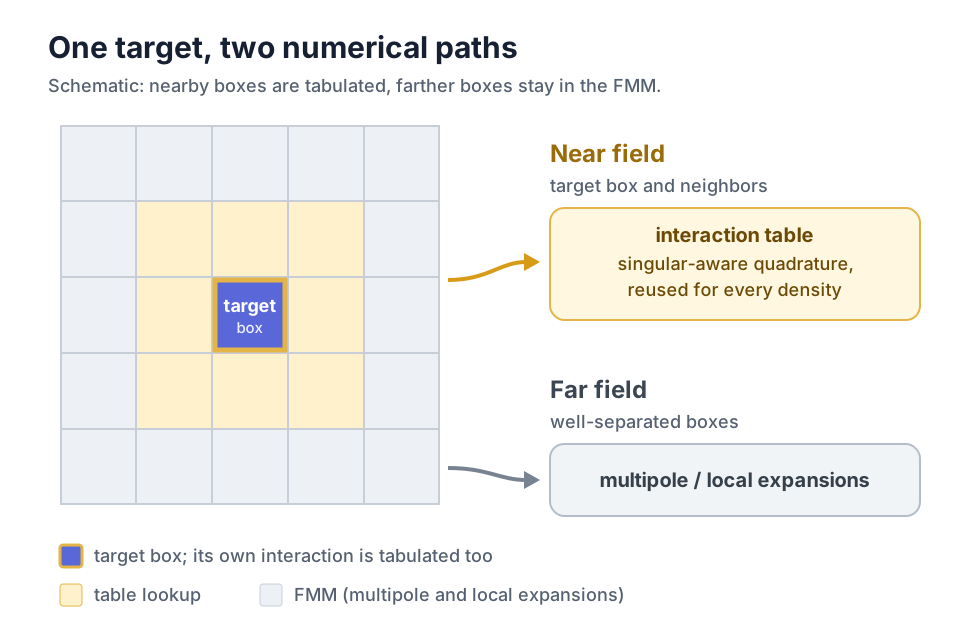
Schematic, not computed output: a uniform neighborhood. Adaptive traversals add relationships between levels, but the split is the same: difficult local integrals are tabulated; well-separated interactions stay on the ordinary FMM path.#
Why the neighboring boxes are special#
For a volume potential
the target can lie inside the source box. The kernel is then genuinely singular. In neighboring boxes it is finite but near-singular. The tensor-product point quadrature that is perfectly useful for well-separated particles is the wrong tool for those interactions.
Volumential therefore changes how the local interaction is evaluated, not the far-field algorithm.
What is tabulated#
For a fixed kernel, dimension, quadrature order and source-box scale, the near-field table stores the integral of the kernel against the source basis for each target node and relative interaction case. Building those entries uses singular-aware quadrature; applying them later is a lookup/reconstruction operation.
That is why the table can be reused when the source density changes. It is about the local geometry and kernel, not about the values of \(f\) in one run.
What still goes through the FMM#
Well-separated boxes use the volume quadrature nodes as weighted particles.
Multipole and local expansions are ordinary sumpy/FMM machinery. The two
paths are accumulated into the same target potential.
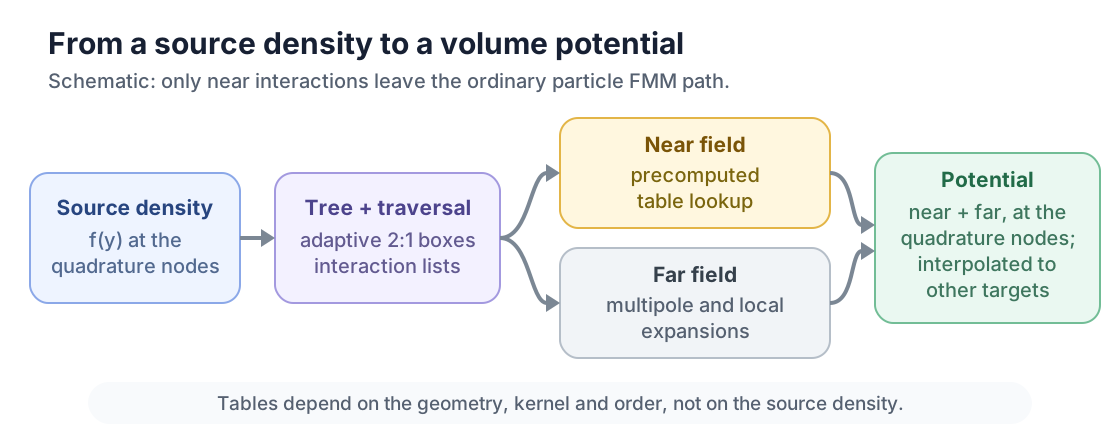
Schematic, not computed output: the two paths of the computation. The volume-FMM workflow names the objects and modules behind each box.#
On a graded tree#
An adaptive tree is kept 2:1 balanced: leaves that touch differ by at most one
level. That keeps List 1 inside the cases the table stores, neighbours of
half, equal and twice the size of the target box, and the far field needs
nothing more (volumential.tree_interactive_build).
It does let one kind of far-field pair come closer than the others. A box can
be split while a neighbour of the same size stays a leaf, and that leaf then
reaches the children of the split box that do not touch it through List 4. It
is twice the size of such a target box and only half its own size away from
it; a List 2 or List 3 source is never closer than its own size. The far field
integrates it like every other source, by point quadrature at its nodes, and
at half a box size that quadrature is much worse. On 2-D trees graded over two
or three levels, at q_order 4 to 8, the error these pairs add is 7 to 2800
times the error of the far pairs one to two source sizes away, and the gap
grows with q_order.
In the total error they are a minor term so far. On a 16 x 16 tree refined
twice around a narrow source (535 leaves on levels 4 to 6), at q_order 8 they
account for 21% of the max error, which is 2.9e-9, and 2% of the relative L2
error; at q_order 4 they do not show. Integrating them from an upsampled
source is #178, which has
the measurements.
Where symmetry enters#
The tabulated neighborhood contains many interactions that are equivalent under box symmetries. Volumential stores canonical cases and reconstructs the others online instead of storing every geometrically equivalent entry.
Continue with:
Near-Field Symmetry Reduction for orbit canonicalization, compact storage and reconstruction;
Near-field table build routing for how a cache miss chooses a builder and how provenance is recorded;
The volume-FMM workflow for the complete pipeline and the modules that own each stage.
This page is deliberately conceptual. Those pages remain the source of truth for the exact interaction-case encoding, adaptive traversal details and cache payload.